Lead a vivid life that does good

Category: Leadership (Page 2 of 10)

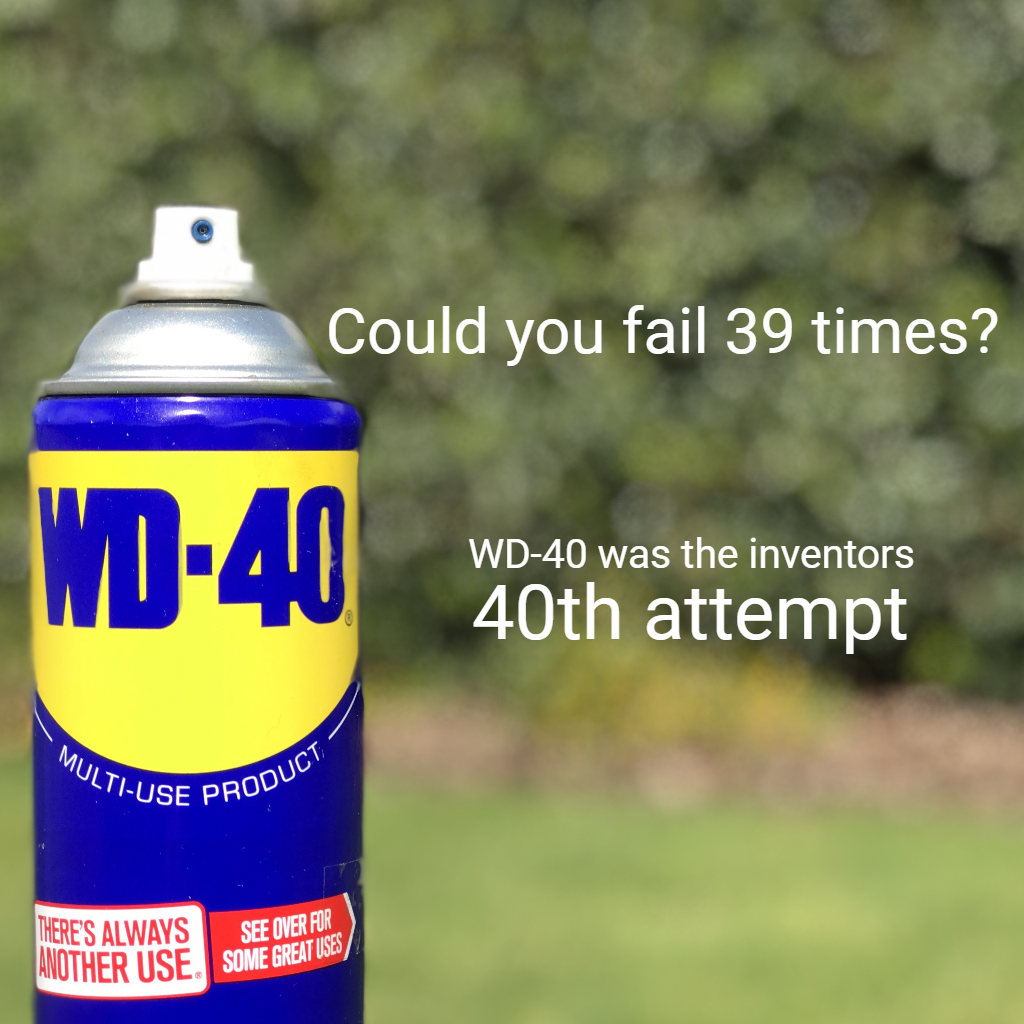
Could you fail 39 times?

Would you give up on the 39th AttemptI learnt recently that WD-40 stands for “Water Displacement 40”. The 40 means it was his 40th attempt at developing the product.

The  inventor Norm Larsen had tried 39 times to find a way to displace water to stop rusting in the aerospace industry.

When he finally succeeded on his 40th attempt he created a product that has far more uses that just the problem he was seeking to solve.

WD-40 would not exist if he & his team of three had given up on their 31st attempt.

I love that each time I use this product, the name itself, will be a reminder that sometimes failure upon failure is needed before success can occur.

Leaders are NOT readers

Leaders are NOT readersYou’ve heard the saying “Leaders are readers.”

I no longer believe that is true!

That’s because just reading for reading’s sake is not a healthy leadership trait.

Great leaders are educators.

Meaning, they are always learning.

And always teaching.

They do this by reading, for certain! They are also podcast listeners; video watchers; conference attenders and intellectually curious.

Leaders learn wide, across many topics. This stops narrow-mindedness and gives them the ability to point the people they lead in the right direction.

Leaders also learn deep, digging into a few topics in detail. Which gives them the wisdom and experience to radically change how they lead.

People don’t want to follow a leader with empty knowledge.

People want to follow leaders with wisdom.

Experience.

And knowledge.

Great leaders are great learners and therefore great educators.

Are you learning wide & deep to become the leader you need to be?


Footnote worth remembering: The saying “leaders are readers” was coined in the 1800s when reading was about the only option for learning.

Living with slightly embarrassing

Should we kill perfectionism?We no longer live in a world where everyone feels the need to always strive for perfection.

As a leader and self-diagnosed perfectionist this poses some big challenges.

  • There are no perfect decisions; more time, does not equal more right. In fact, the sooner you decide, the sooner you move forward and learn.
  • There is no perfect design; as everyone has different tastes and opinions.
  • There is no perfect strategy; as all plans change as they encounter the real issues in the marketplace.

In the startup and knowledge economy I’ve come to understand that perfect is the enemy of speed. Which is why at coHired, our company-wide number one priority includes the phrase “deliver a slightly embarrassing product”.

Slightly embarrassing means that we collectively kill perfectionism, knowing that the best path to perfect is by delivering the imperfect and learning from it.

If you’re a struggling perfectionist like me, here’s a tip:

I’m learning to break my perfectionist tendency by giving the work I would normally try to ‘perfect’ to someone else. It’s almost guaranteed they won’t do it the way I would, which means it won’t be my kind of ‘perfect’, but it almost always is great enough to move forward.

How to get promoted!

“What did you do to get promoted?” she asked, hoping for a leadership gem.  “I got lucky” I said, knowing it wasn’t the whole answer.

I had just been sharing about the period of my life where I went from being a courier to a senior manager in New Zealand’s largest courier company over a five-year period.

To be honest ‘luck’ played its part. I joined when the company was growing exponentially and promotions created spaces. But luck alone doesn’t account for it. There were a bunch of other people who didn’t get promoted.

I believe I was promoted because I locked on to an axiom early on in my career;

Do all of my job and half of my boss’s

Doing ‘all of my job’ stopped by boss having to jump in and do it for me. [Note: If your boss is doing some of your job, fix that first. Not cool!]

Doing ‘half of my boss’s job’ meant I was learning outside my existing roles and helping my boss. When opportunity popped up, I was a logical choice.

Trying to do one and a half jobs, doesn’t mean I worked 1 1/2 times harder. It is hard work, but it also taught me to lead my teams better and focus on what was important.

“Do all of my job and half of my boss’s job,” clearly won’t work in every setting. But maybe it’s worth a try.

Nowadays being a CEO/Founder it’s a lot harder to do my boss’s job, but my focus remains largely the same. I need to ‘Do my job and half of my future job.’

If I want to the organisations I lead to have a global impact, the leader I am today is not sufficient for the future.

Re-framing Failure

What have you learnt from the gift of failure this week

“I hate the word failure and wish it never existed,” I stated as strongly as I could as we reflected on some past experiences.

I shared that the problem with failure is its opposite seems to be pass.

The problem with pass is it has a strong mental connection to school or uni, where you pass or fail.

If you didn’t pass.

You failed.

You were a failure.

Nowadays, particularly in start-ups, ‘failing often’ or ‘failing fast’ is seen as a badge of honour. Because you can learn so much from failure.

Which is why I love how schools are trying their hardest to re-frame the word failure.

My friend who I was sharing all this with said that each Friday, his daughter is asked at her primary school, “What have you learnt from the gift of failure this week?”

Isn’t that a great question! Take another look.

What have you learnt from the gift of failure this week?

I realised in that conversation that I need to intentionally re-frame the word ‘failure’. To stop hating on it.

It should no longer be linked to pass or fail. Rather it should be linked to all the successes I have had as a result of learning from my failure.

Failure can be a gift.

If you learn from it.


What have you learnt from the gift of failure this week?

[pause]

[reflect]

Have you learnt anything?

Because if you haven’t, maybe your stuck in your comfort zone again.

Great Leaders Flip-Flop!

Great Leaders Flip FlopIt’s election year. This means you will hear two phrases in the media over the next 6 months. They are the terms “flip-flop” and “U-turn”.

The media is exceptionally good at spotting a flip flop or U-turn in the opinion of a candidate. While keeping the politicians ‘honest’ is important, I get concerned when the media portray changing your mind as a bad thing!

It’s not.

Authentically changing your mind is a strength.

Which type of leader would you rather follow?
– A person who is close minded to change.
– Or a man or a woman who authentically considers the evidence, and changes their mind.

For some reason society often frowns upon those who change their minds.

Personally, I’d rather be seen as a flip-flop leader.

Are you prepared to change your mind?

More importantly if you are presented with new evidence or feedback on a belief you hold dearly, would you change your mind?

Changing your mind or beliefs or attitudes is actually far harder than it seems. Far easier to stick with the status quo.

Which is why, great leaders flip-flop!

Letting Go

If you want people to grow - you have to let go“You don’t understand,” I said partly in jest, “It has nothing to do with their fear of change. It’s ALL my own insecurities.” As soon as I heard the words leave my mouth, even though I was meaning them to bring humour, I knew they were true.

I was trying to work out what my role should be in Agoge, the social business I founded and own. Hearing these words changed everything. I realised that so much of my identity and status and self-esteem was tied to being the leader.

And allowing my insecurities to win, would eventually lead us to lose.

This week Jim Grafas, was promoted to CEO of Agoge. I couldn’t be more excited to see a person who I trust and who is an amazing friend take the role. More importantly he is a phenomenal leader who people love to work with, who deeply cares for people, and who passionately believes in Agoge’s vision of People Matter ∴ Do Good.

I will tell you something else about Jim. He doesn’t yet know everything he needs to know to be CEO, which means he will make mistakes. Which is exactly how he will grow.

If I allowed my insecurities to stop me stepping out of the way. Then I not only stop myself growing, I stop Jim, and the amazing team beneath him from growing as well.

If you want people to grow, you have to let go.

Since having the insight about my own insecurities, it’s amazing how often I have heard it in others. So many leaders and managers and even parents are holding great people back, purely because they won’t let go.

Our role is to help people grow into the best possible version of themselves.

We don’t do that by holding on.

We do it by letting go.

If you want people to grow, you have to let go.


———————————
Finally in case you’re interested. I haven’t retired. I’m now the MD of Agoge and still passionate and emotionally invested in its future. I’ve also teamed up with Vivek to co-found a new social business, that aims to have the same ethos and purpose that Agoge does, but solve a different problem.

How much do I get paid?

Pay Kids for inventionsAround our house we have duties that everyone has to do each week on rotation as a part of being in the family. Then there are the tasks like mowing the lawns which I can do for free, or the kids can do for money.

Of course the first question is “how much do I get paid?”

We are taught from an early age to value our time when we work. We are rewarded for the hours we put in, not the outcomes.

Which is weird, because as adults we know true success is not determined by how much we earn.

Success is defined by what we do.

What we learn.

What we create.

Invent.

Start.

Who we help.

Connect.

Love.

And how we shape the lives of people around us.

I’m not sure I want my kids to grow up with a ‘wage’ mentality. I would rather they have a ‘change’ mentality.

Maybe those of us with kids should start paying them for the hours they aren’t on devices or watching TV.

We could pay them to read, or exercise, or learn new stuff they don’t teach at school.

We could start offering to pay our kids when they are writing, or creating, or making art.

Better yet, we could pay our kids for each invention they make, regardless of how successful. Or fund any social project, no matter how short-lived.

I’m sure there will be a downside to all of this, but it must be better than just paying them to mow the lawns

Choosing to be colourful

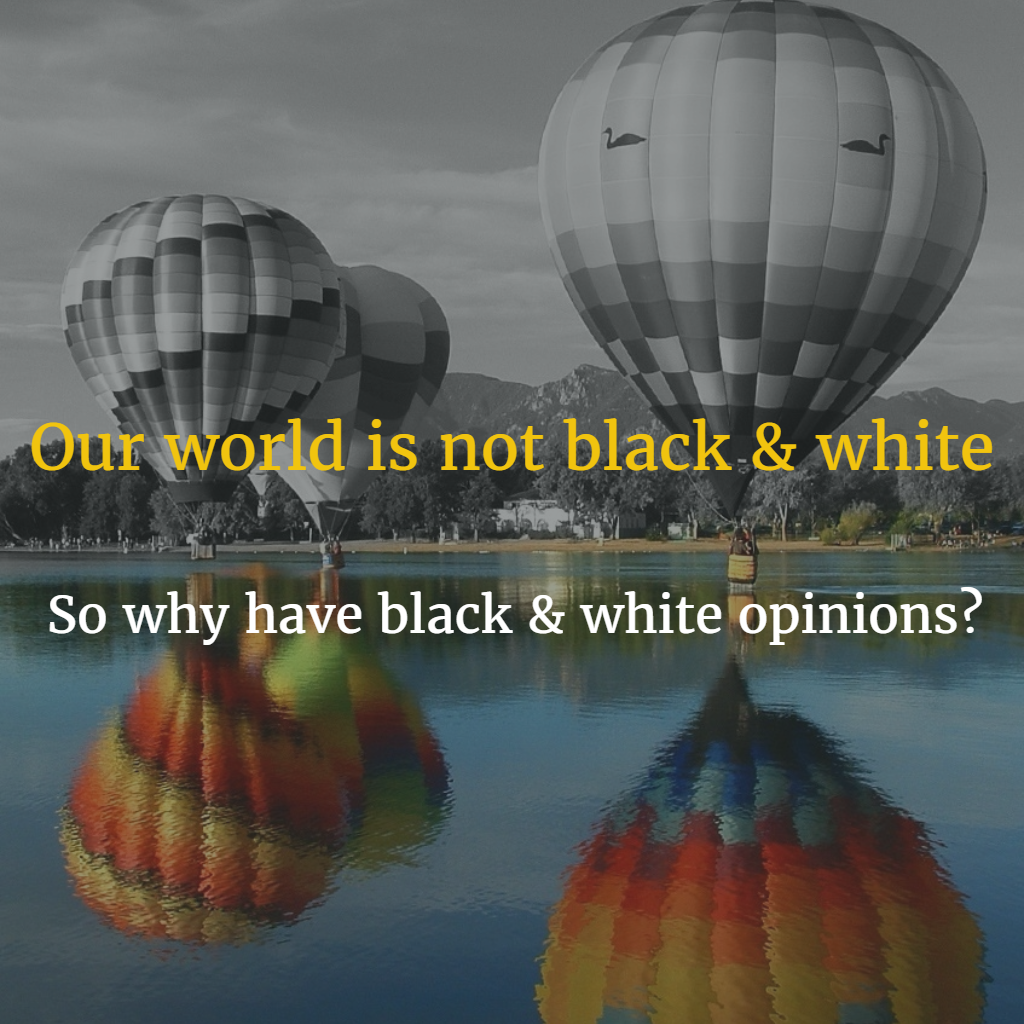
Our world is not black & white So why have black & white opinionsAs a kid growing up we had a black and white TV in my parents room, and a colour TV in the lounge. As you can imagine the difference when switching between the two was stunning.

Equally as stunning is the difference in us when we are being black and white, compared to when we are colourful.

Black and white people say I’m either terrible at something or brilliant. Colourful is the middle possibility, I’m just fine.

Black and white people get locked in to one political view or vote based on what they want. Colourful seeks out what’s best for everyone.

Black and white people only read and learn to support and strengthen their existing view. Colourful causes them to read and learn at the edges.

Black and white leaders do what they’ve always done and believe they have the answers. Colourful leaders challenge others to push boundaries.

Colourful isn’t about abandoning everything you believe, rather it is about allowing it to be challenged.

Our world is not black & white. So why have black & white opinions?

Think back at last week … did you become more black and white, or did you become more colourful?

Make it your goal this week to become more colourful.

How to build momentum

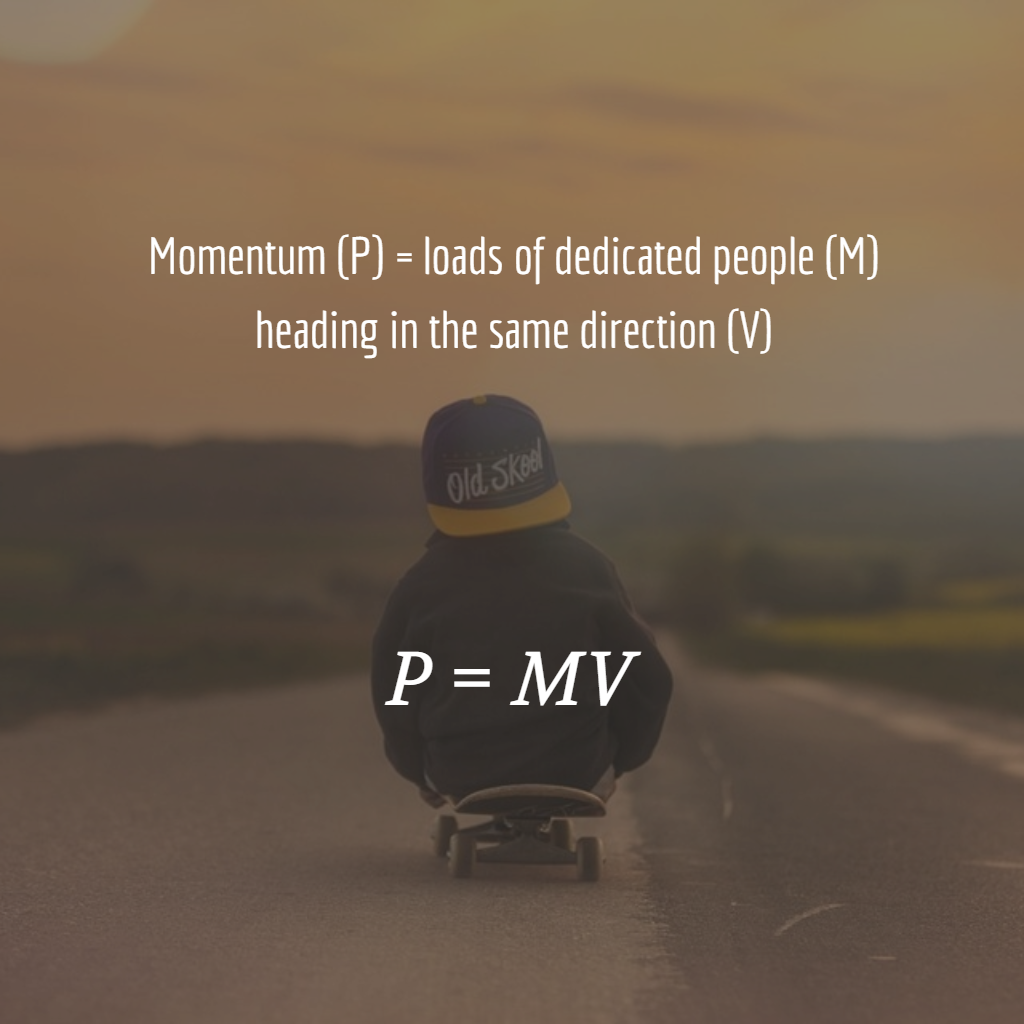
Momentum equals mass x velocity P MV

One of the things my son and I do for weekend kicks is launching ourselves down our street, which has a reasonably steep hill, on skateboards. There’s something about gaining momentum that is fun and exhilarating. And as the formula P = MV rightly points out, the bigger you are the faster you go.

As a social entrepreneur I also love momentum. I love growth. I’m not scared of BIG, and I not so secretly desire to use the organisations I am involved in, to have a global impact. I want them to take over the world and do good.

I also want the organisations you are involved in to succeed. And grow. And gain momentum. That’s where the formula comes in.

Momentum (P) = Mass (M) x Velocity (V)

Momentum in an organisation requires Mass & Velocity.

Mass

Mass equals people. Without people there is no momentum.

It would be easy to think, that the more people you have the more momentum you have, but that’s only partly true. Mass is about density. And density when it comes to organisations is about quality.

100,000 likes might increase awareness, but it won’t bring long-term momentum on its own. What organisations need are dedicated, high quality people, who do great work and bring mass.

Mass is about getting as many great, activated people as possible.

Velocity

Velocity is different from speed. Speed is how fast something is moving, whereas velocity how fast it moves in a direction. Velocity is heading somewhere.

If you have 100 people moving incredibly quickly in different directions, then they are pulling against each other. You have speed, but not velocity.

In an organisation, everyone needs to be moving fast AND in the same direction.

Without velocity you have no momentum.

So…

Momentum (P) = loads of dedicated people (M) heading in the same direction (V)

[Science lesson over]

Now consider the organisations you are involved in. Do they have momentum?

More importantly.

Are you doing your best to bring Mass (dedicated involvement) & Velocity (heading in the same direction)?

We can all be apart of something big that has incredible momentum.

We just cant do it without climbing on board, and then launching ourselves down the hill.
« Older posts Newer posts »