Lead a vivid life that does good

Category: Life Lessons (Page 3 of 8)

Why cutting corners matters!

When you cut corners often enough, people will follow your example.The road ahead of us bends to the left and intersects with our small cul-de-sac which climbs off to the right. With our ‘L‘ plates front and back, and me in the passenger seat, I clearly instruct the first time driver “don’t cut the corner”. It is after all a perfect corner for cutting. My words echo around the car as she whips right, cuts the corner and heads towards home.

“What part of ‘don’t cut the corner’ did you not understand?” I banter.

“You do it all the time” my daughter factually quips.

Instantly I realised that’s what I do. I cut that corner. Almost every time.


A few years ago a friend of ours was in a recovery programme. As a part of the programme they would often go for long walks around urban streets. As you know, footpaths generally curve around the intersection and then cross a few metres into the next street, so that its safer.

They had to ALWAYS cross where the footpath crosses the road.

They weren’t allowed to cut corners.

Ever.

Even if the roads were empty they still go the long way, because they wanted to reinforce that there was no cutting corners when it came to their recovery.

I cut those corners too.

Often.

Without even thinking about it.


We cut corners in life repeatedly. Usually because its quicker or easier or the least expensive way. What we often don’t see when we cut corners, is the message that sends to those around us. To our children, students, work-mates or even people we lead.

When you cut corners often enough, people will follow your example.

Realising that I cut corners more often than I thought, has made me resolve some areas I never want to cut corners.

Honesty.

Safety.

Finances.

Caring for people.

Relationships.

Because cutting those corners will leave me a lesser person.
Does familiarity stop you listening?

Often our familiarity with a person can stop us hearing the wisdom they offerRecently I was having coffee with a guy who had taken some advice I have given him and was raving about it. The funny thing is that he confessed to me that one of his team had given him the same advice a few months earlier and he had largely ignored it.
Often our familiarity with a person can cause us to be less receptive to a person’s opinion.

Our familiarity to our leaders, colleagues, team mates, parents, partners, or even kids can make us disregard the insights they offer.

We often have incredible respect and trust for those closest to us. We know their strengths, weaknesses and are in constant conversation with them. And all this familiarity can lead us to not even consider the firsthand wisdom they offer.

If we do this often, they will stop speaking into our life.

What a loss that would be.

There is a twofold implication for familiarity…

Firstly, we need to remember to not only listen to those closest to us, but also to take time to truly consider their opinion, rather than just shrug it off.

And, there are times when we really need to hear the truth by listening to someone who doesn’t know us well and who is respectful enough to be candid about their opinion. It can make us feel a little bit foolish, but at least we have no choice but to take notice.

The easiest path, if we’re honest, is through those closest to us.

The story that shapes your life.

The Story you tell yourselfIn my final years of high school I was labelled. I was average (to below average). I lacked discipline. I needed to work harder. It would have been easy for me to accept that story and have it define my life.
What your schools, friends, colleagues and even family say about you is far less important than it seems.

Far more important is the story you tell yourself.

You get to choose the story that shapes your life.

No one else.

Fortunately, the person I am today is dramatically different to the person I was 20 years ago.

Over the years I’ve learnt that its not the things I am told that hold me back. It is almost entirely the things I tell myself.

And to be honest, the stories we tell ourselves are a lot harder to change than we think.

BUT (I use this word intentionally), they can be changed.

That should give you great hope for the future.

Does fear steal freedom?

Fear takes freedomLast week I was out running with Jay tagging along on his bike. As I ran, a seagull became increasingly disturbed with my presence and finally started dive bombing me. We sought shelter under some trees and, once the bird was over it, we carried on.

It is fair to say Jay was freaked out by the bird. He was afraid or fearful.

Like all fear if it was left unchecked, it would steal his freedom. If he allowed himself to become afraid of all seagulls or even all birds then he could avoid beaches or places where there are a lot of birds. When that happens freedom is lost.

Ultimately that’s what Terrorism does. Makes us fear and give away freedom by avoiding travel or amazing experiences.

So does a fear of failure.

Or a fear of meeting new people.

Or even a fear of asking ‘dumb’ questions.

Fear is the opposite of freedom.

Next time your stomach churns a little, your heart races and fear starts to set in. Stop and check that fear … is it something you should really be afraid of?

Or is it a call to step out.

To be bold.

Is it a call to freedom?

‘Kinstugi’ the art of turning Brokenness into Beauty.

Kinstugi Brokenness‘Kinstugi’ is the Japanese word that describes the art of repairing broken ceramics with gold.
This art form is wonderful in the way it takes something that is broken, destined to be rubbish.

And restores it.

With gold !

Once repaired, it is considered more beautiful for having been broken.

Often brokenness from our past are considered ugly scars, that we need to hide, and never speak of again.

Wouldn’t it be cool if we took the art of Kinstugi and applied the thinking to our lives.

What if we understood that the times we feel smashed and broken are gold in the making?

What if our past brokenness was seen as gold lines that speak boldly of our journey and healing?

What if that was Jesus intention, to take our brokenness and use it to make us more beautiful?

Re-solving the New Years Resolution problem.

Happy New Year!

By now a few of you are 5 days into your New Years Resolution. While others, like me, are yet to set some as we come back from our summer holidays.

Wherever you are on your resolution cycle here’s a thought …

resolve - new years resolutionResolution comes from Resolve.

Resolve means to have a determination to take a course of action. Like going to the gym, or learning french, or blogging.

Resolve comes from two words ‘re-‘, meaning to do again and again. And ‘solve‘, meaning to find a solution to a problem.

And so a big part of having resolve is to know what problem you are trying to solve. The goal of going to the gym is generally not going to the gym. Rather its Losing weight, getting fit or having rock hard abs. Knowing what you are trying to solve is the key to the story.

Once you have the story, and the power for self-discipline is in the story. Use the story to ‘re-‘mind yourself almost daily so that you have the ‘re-‘solve, the determination to actually head to the gym.

Or learn.

Or blog.

Self discipline is hard. I believe for me personally it becomes almost impossible without ‘re-‘solve, without the story.

So when you start to struggle to meet your goal, and you will, don’t forget to remind yourself of the story of who you are trying to become, and remember …

You can and will achieve it!

Take care of your brain

Take care of your brain“Yes I’ve put that in my ‘stuff up’ folder” was the reply as we discussed a small error that one of my team had just made. Now the error the person had made was on a task they had never done before, (ever!) and hadn’t been trained for, but they labelled it a stuff up.
Immediately I replied you shouldn’t be calling it a ‘stuff up folder’. A ‘learning’s folder’ maybe or a ‘helpful notes’ folder, but when you use the term ‘stuff up’ you tell your brain that you failed.

We do this often as human beings. Use destructive language on ourselves. By tagging it as a ‘stuff up’ we run the risk of telling ourselves a story of failure and if that goes too far, we become scared of risk and trying new things.

There are of course many forms of ‘stuff ups’

I always do that wrong…

I’m useless at …

I could never …

Sometimes they are really valid.

But often they are phrases we need to single out for what really they are, and intentionally replace with positive statements. And by doing so, we take better care of our brain, and free ourselves up to learn more.

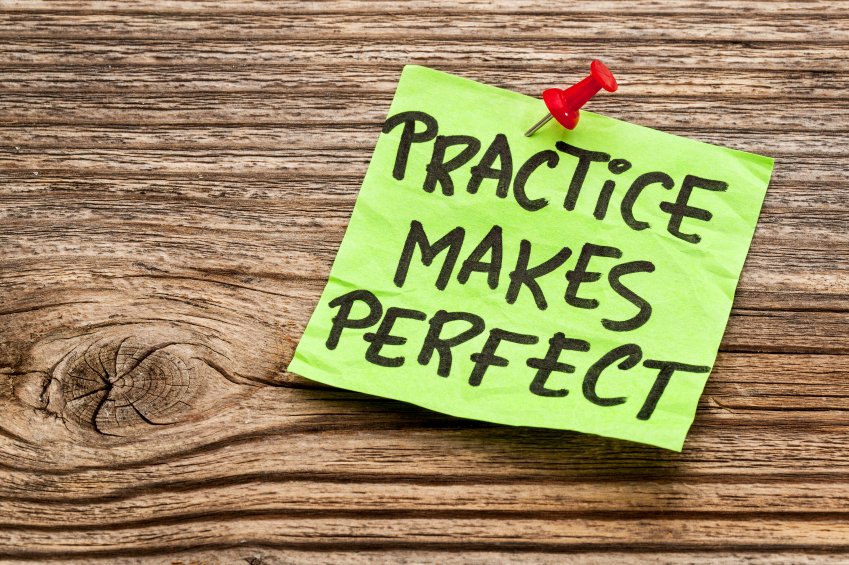
The downside of ‘Practice makes you perfect’

practice makes you not badI’m sure you have heard the phrase “practice makes perfect” many times in your life. You may have even used it on your children or other people you know.

Indeed if you want to get as near as possible to perfect in something, practice is the key. Usually at least 10,000 hours of it.

But before practice makes perfect is … practice makes you great.

Before that … practice makes you very good.

Before that … practice makes you good.

Before that … practice makes you not bad.

Not bad, it turns out, is significantly better than almost everyone else. And ‘not bad’ takes a whole lot less practice than what is needed to be perfect. More importantly ‘not bad’ can often be enough to get you through.

Sometimes our desire to be perfect is the very thing that stops us starting in the first place.

‘Practice makes you not bad’ still takes practice and a decision to start. It’s just the goal is different and the pressure is off.

It may be guitar. Or a language. Or sport. Or maths. Or computers. Or even work. Being not bad takes far less than we expect.

The challenge for me is to stop trying to be a perfectionist all the time, and to be happy with not bad. Because when I’m happy with not bad, it actually makes practice easier and more enjoyable.

Maybe that’s the case with you as well.

And for your kids.

Its the question that could change your life…

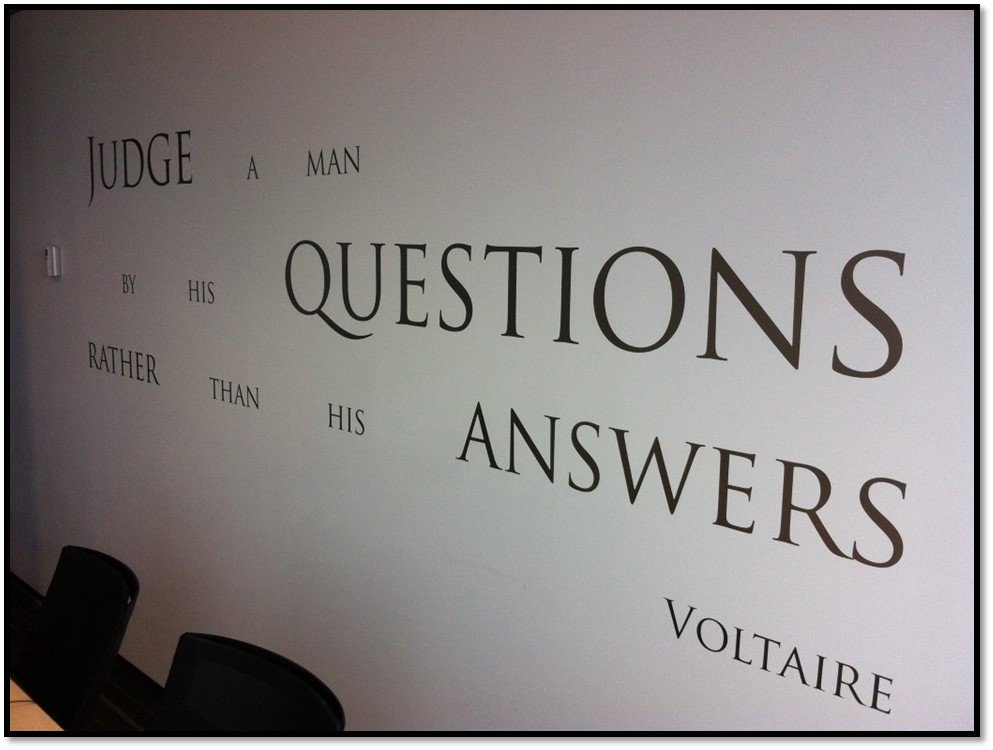
Judge a man by his questionsFor those who know me, you will know one of my favourite (and at times most frustrating) questions is “How do you mean?”
It’s a favourite question because it softer than “What do you mean?” and because it is a great way to find out exactly what the person is saying or thinking or trying to explain. It causes me to pause and be sure that I know, rather than assume I know, what the person is saying.

And as great as this question is, the most important thing is that it is a question.

There is so much power in questions. So much ability to draw in and hear what people are really saying. So much power to fully understand them.

A recent study of people involved in negotiation showed that the average person spends 11% of their time asking questions, but for the most successful negotiators this number more than doubles to almost 25% of their time. Just asking questions.

Effectively the best negotiators are people that … ask.

Listen.

Ask.

Hear more.

Ask again.

Until they fully understand the other persons point of view. And because of that they win people’s hearts, and reach agreement, and get positive movement.

All through the power of questions.

The weird thing about asking questions is that it makes me appear way smarter than I am. Often the mere act of asking questions causes people to think in ways they haven’t before. And they come away from our conversation thinking I helped them with wisdom, when all I really did, was ask questions.

So the next time you’re trying to help someone, or understand a problem. Try asking 5 questions (way harder than it sounds) before even trying to give your opinion.

When you do this, you too will discover the power of questions.

The hidden power of belief

believe_in_yourselfI was reading a study where people were given the opportunity to buy the exact same pain-killer, but packaged in different ways and costing different amounts of money. They then followed up to see which drugs worked more effectively, and discovered that the more expensive the drug, the better people ‘believed’ it worked.

Think about that. We buy a more expensive version of EXACTLY the same pain-killer, and because we believe it’s better … it is better!

Belief is probably one of the most powerful predictors of success I can think of.

Want to lose weight? If you believe you can do it and believe in a programme, you are half way there.

Want to become a more patient parent? You need to believe you can be more patient.

Want to change a habit? Belief is critical.

You can achieve things you never thought possible.

You just need to believe in yourself.

The issue with belief, is so many of us have stopped believing we can. Which means that we believe we CAN’T, and changing what we believe is incredibly hard. Our self-talk is incredibly powerful.

Often believing comes from small successes, so if you are struggling with belief start by setting a really small, short-term goal (maybe 3 weeks away) and work on it every day.

You will nail it.

I know you will, because I believe in you!


« Older posts Newer posts »