People Matter ∴ Do Good

Lead a vivid life that does good

Page 8 of 43

Take care of your brain

Take care of your brain“Yes I’ve put that in my ‘stuff up’ folder” was the reply as we discussed a small error that one of my team had just made. Now the error the person had made was on a task they had never done before, (ever!) and hadn’t been trained for, but they labelled it a stuff up.

Immediately I replied you shouldn’t be calling it a ‘stuff up folder’. A ‘learning’s folder’ maybe or a ‘helpful notes’ folder, but when you use the term ‘stuff up’ you tell your brain that you failed.

We do this often as human beings. Use destructive language on ourselves. By tagging it as a ‘stuff up’ we run the risk of telling ourselves a story of failure and if that goes too far, we become scared of risk and trying new things.

There are of course many forms of ‘stuff ups’

I always do that wrong…

I’m useless at …

I could never …

Sometimes they are really valid.

But often they are phrases we need to single out for what really they are, and intentionally replace with positive statements. And by doing so, we take better care of our brain, and free ourselves up to learn more.

How to use an email to make someone’s day!

Nicest person on the face of the planet“You’re the nicest person on the face of the planet! Thank you for being so gracious” was the response to me from one of the staff at a partner organisation, that does amazing work in bringing clean water to millions of people. All I had done was make their life a little bit easier by not pursuing a minor issue, and I received that response.

Of course I’m not “the nicest person on the face of the planet,” and I’m not sure any individual can be.

But for a brief moment, when I read the email…

I felt like I was!

Her comment reminded me, that in every email interaction, we have the opportunity to make audacious statements that makes the recipient feel incredibly special.

Even if it’s just for a moment.


The downside of ‘Practice makes you perfect’

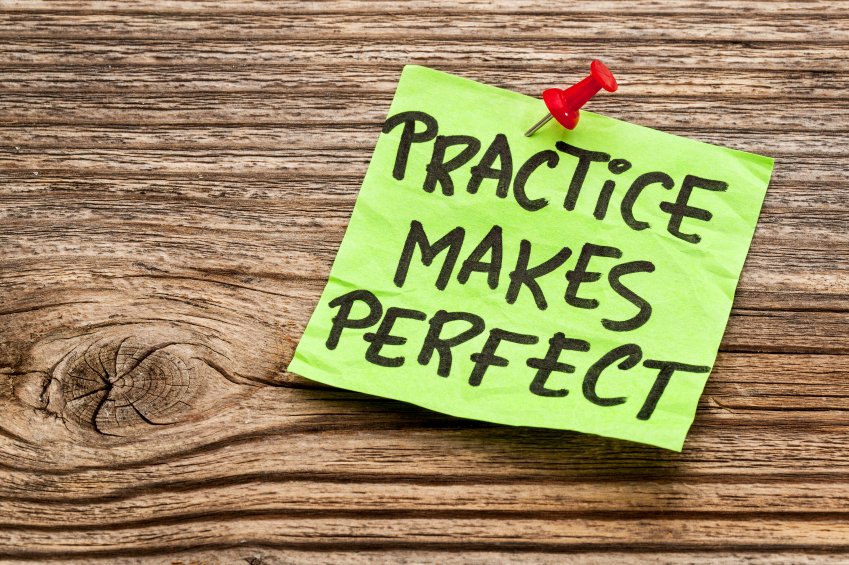
practice makes you not badI’m sure you have heard the phrase “practice makes perfect” many times in your life. You may have even used it on your children or other people you know.

Indeed if you want to get as near as possible to perfect in something, practice is the key. Usually at least 10,000 hours of it.

But before practice makes perfect is … practice makes you great.

Before that … practice makes you very good.

Before that … practice makes you good.

Before that … practice makes you not bad.

Not bad, it turns out, is significantly better than almost everyone else. And ‘not bad’ takes a whole lot less practice than what is needed to be perfect. More importantly ‘not bad’ can often be enough to get you through.

Sometimes our desire to be perfect is the very thing that stops us starting in the first place.

‘Practice makes you not bad’ still takes practice and a decision to start. It’s just the goal is different and the pressure is off.

It may be guitar. Or a language. Or sport. Or maths. Or computers. Or even work. Being not bad takes far less than we expect.

The challenge for me is to stop trying to be a perfectionist all the time, and to be happy with not bad. Because when I’m happy with not bad, it actually makes practice easier and more enjoyable.

Maybe that’s the case with you as well.

And for your kids.

Its the question that could change your life…

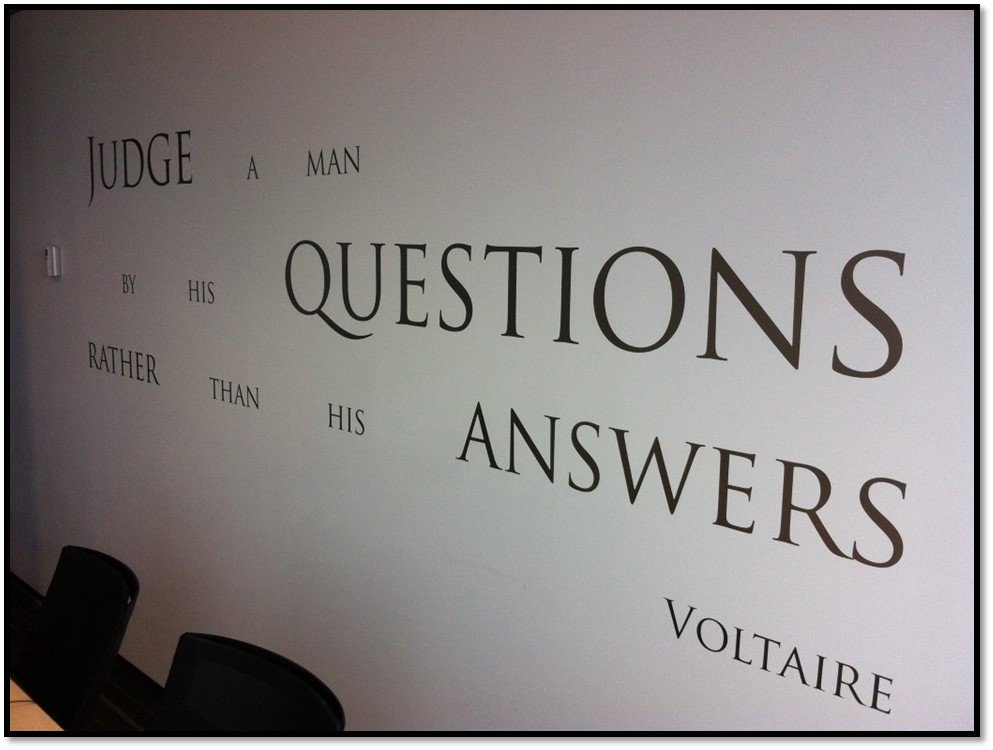
Judge a man by his questionsFor those who know me, you will know one of my favourite (and at times most frustrating) questions is “How do you mean?”

It’s a favourite question because it softer than “What do you mean?” and because it is a great way to find out exactly what the person is saying or thinking or trying to explain. It causes me to pause and be sure that I know, rather than assume I know, what the person is saying.

And as great as this question is, the most important thing is that it is a question.

There is so much power in questions. So much ability to draw in and hear what people are really saying. So much power to fully understand them.

A recent study of people involved in negotiation showed that the average person spends 11% of their time asking questions, but for the most successful negotiators this number more than doubles to almost 25% of their time. Just asking questions.

Effectively the best negotiators are people that … ask.

Listen.

Ask.

Hear more.

Ask again.

Until they fully understand the other persons point of view. And because of that they win people’s hearts, and reach agreement, and get positive movement.

All through the power of questions.

The weird thing about asking questions is that it makes me appear way smarter than I am. Often the mere act of asking questions causes people to think in ways they haven’t before. And they come away from our conversation thinking I helped them with wisdom, when all I really did, was ask questions.

So the next time you’re trying to help someone, or understand a problem. Try asking 5 questions (way harder than it sounds) before even trying to give your opinion.

When you do this, you too will discover the power of questions.

Smart people make things simple.

For many people, one of the biggest curses of knowledge is that we tend to over complicate things.

Case in point, I have been doing a lot of reading about Lean Manufacture and its application into the service industry. One book I slaved through this week explained Waste in a complex way that cumulated in the formula shown in this picture (for the record I have no idea what this actually means.)

LEAN Waste Forumla

And then, I read a simple explanation in a completely different book. Waste is non-valued added time. I.e. Doing things that don’t add value to your customers, that’s waste.

The goal of both books is to make Lean Service understandable and applicable, and yet one failed miserably.

The goal of leading people is not to show how much knowledge we have or make us feel smart. The goal is to lead our people to do great work, by keeping things as simple as possible.

The simpler we make that, the better.

The hidden power of belief

believe_in_yourselfI was reading a study where people were given the opportunity to buy the exact same pain-killer, but packaged in different ways and costing different amounts of money. They then followed up to see which drugs worked more effectively, and discovered that the more expensive the drug, the better people ‘believed’ it worked.

Think about that. We buy a more expensive version of EXACTLY the same pain-killer, and because we believe it’s better … it is better!

Belief is probably one of the most powerful predictors of success I can think of.

Want to lose weight? If you believe you can do it and believe in a programme, you are half way there.

Want to become a more patient parent? You need to believe you can be more patient.

Want to change a habit? Belief is critical.

You can achieve things you never thought possible.

You just need to believe in yourself.

The issue with belief, is so many of us have stopped believing we can. Which means that we believe we CAN’T, and changing what we believe is incredibly hard. Our self-talk is incredibly powerful.

Often believing comes from small successes, so if you are struggling with belief start by setting a really small, short-term goal (maybe 3 weeks away) and work on it every day.

You will nail it.

I know you will, because I believe in you!


3 ways to stay focused on your goals

FocusA number of years ago Bill Gates’ mother held a dinner party and invited both Warren Buffet (super rich guy) and Bill along. At the dinner party she ask what they believed was the single most important factor for their success. Both Bill and Warren gave the same one-word answer: “Focus.”

Focus is one of those annoying words that continually collides with my life. Historically I would not regard myself as a particularly focused person, but slowly over the years I have been improving. As I have improved I have realised that FOCUS requires constant, well focus, on three areas:

1. Turning Goals into Priorities

In order to be focused you must know what you are focused on. The word after all means “the centre of interest or activity.” Without having goals, both in business and personally, you won’t have interests or activity to centre yourself on.

But just as important as having goals, is reviewing them very frequently and setting actions. For me this involves a weekly review of my goals and strategies to set the course for the week, then almost daily reviewing these and setting actions for my day ahead.

Simply said. To focus you must have goals and resolve to take action daily.

2. Be in the Right Space

Now that you have your priorities you need to have a work-space where you can actually get on and do the work without too much interruption. As your all know, not all work spaces are the same. Some of us have our own office and others work in open plan.

The key thing to remember is that different focus, requires different spaces. Sometimes I need to work in my office as I need the tools there to do the work. Other times I can sit with my laptop in a café. Other times I go on a walk with a piece of folded up paper and a pen (so I can leave my phone behind). Depending what you are focusing on determines the space you should be in.

Once in the right space and ready to focus, it’s important to eliminate as many distractions as possible. This mainly involves communicating with the team around you that you are focusing a major goal for a period of time.

3. De-clutter ALL Distractions

I was reading yesterday that the average Facebook user in New Zealand checks Facebook 14 times a day. Social media is great for connection with people, but for most of us it distracts us from their goals. Similarly in our work-spaces there are distractions everywhere, so it is little wonder we struggle to focus. As I’ve become more focused I have had to take some pretty radical steps and a few of these are below:

  • Implement GTD (Getting Things Done). It’s a book. Buy it. Implement it.
  • Have a tidy work-space and try to only have the work in front of you, that you are focusing on. This stops distractions.
  • Turn off every type of email notifications on every device. My focus doesn’t last long, the last thing I need when a new email arrives is an excuse for my brain to get distracted.
  • Turn off notifications on your phone. All of them at first, then bring the critical ones back in. Social Media are unlikely to be the ones you turn back on. While you are at it, delete the most distracting apps from your phone.
  • Relentlessly remove yourself from email lists. The goal of an email is to distract you and get you to check in on their website. Our goal is to not be distracted and to have as much focused time as possible.

Distraction is everywhere which makes focus incredibly hard. If focus is important, you need to radically reduce the distraction. You can still clear Facebook, or check out websites. Just not when they prompt you and not when you are focused.

Becoming more focused is a constant struggle for me. I get constantly distracted and interrupted and I take on too much. All distraction comes at the expense of the goals I think are really important for me.

That said, the more I focus, the more I appreciate the value of focus and the more determined I become on my quest for more.

I’d love to hear if you have tips for becoming more focused, so comment and let me know what you think.

Do you have a minute?

Havea minute?I hate running on a treadmill!

Nothing does my head in quite as much as watching minute after minute tick by, while I stay in one place and move exactly nowhere.

It’s funny how one minute can feel like a blink of an eye, but when things are moving slowly or you are watching a countdown each second feels slow and a minute takes forever.

1 minute in the scheme of our lives is not much time. Even in the fullness of a day, one minute only equates to 0.07% of your day. There are 1440 of them each day.

1 minute is nothing. Unless you make it something. A minute every day … can radically transform your life.

The thing about minutes is they build-up. If you were to do a new habit for just a minute a day, you would spend 6 hours on that habit over a year! All from just one minute.

Maybe its writing in a journal. Or meditation. Or prayer. Or exercise (yes 1 minute counts). Or Reading. Or playing with your kids. Or … ?

Do you have a minute?

Just one minute.

Everyday.

Maybe it could change your life!

The other thing about minutes as they seem to extend. Sometimes spending a minute on something daily, is just enough to get you started, and very soon you are spending 5 or 10 minutes a day.

Start small with just 1 minute.

Start today.

Repeat!

Be more trusted, by first trusting.

I remember sitting with a couple of young entrepreneurs a Trustfew years ago as they asked my opinion on their business idea. The weird thing about the conversation is they tried to tell me without actually disclosing what their idea was. They were concerned that I might steal their idea. After playing that dance I got pretty candid with them and told them I had enough business ideas of my own that I will never do, so I don’t really need their ideas.

Furthermore, I told them to go talk to some other people, who might just be interested in stealing their idea. People with deep pockets who could out execute them, but may just make great partners.

Over the years I have met more than my fair share of people who have the wrong default position when it comes to trust. They choose, sometimes because of past hurt, to never trust people until the person has earned their complete trust.

This is so sad and not for the reason that they may expect.

You see, trust works both ways. If you trust me … I trust you … then you trust me more.

If I start trusting you and sense that you don’t trust me, I assume you are untrustworthy. That you lack integrity.

Merely by not trusting others, you may be seen by everyone around you, as a person not to be trusted.

I know that trust is easier said than done…

You will get hurt.

You will have your trust abused.

At times it will cost you money.

And yet … we should trust anyway.

We no longer have an excuse not to learn

Carpe Diem - Seize the DayOver the Christmas holidays I spent a little time doing a course at codecademy.com. It only took a few hours and I learnt a lot, engaged a different part of my brain and can now lead our IT team slightly better.

Codecademy is one of literally thousands of free online courses now available on just about any subject, many of them from world leading schools and universities.

10 years ago, this wasn’t possible. Just 10 years!

20 years ago having access to some of the world’s best, for FREE, was unthinkable.

Now, more than ever before, it is possible to learn and gain experience in your own home.

For free.

The only cost … is your time.

Your discipline.

There are no longer any excuses.

No one to blame other than yourself.

So go, seize the day.


« Older posts Newer posts »