People Matter ∴ Do Good

Lead a vivid life that does good

Page 5 of 43

Choosing to be colourful

Our world is not black & white So why have black & white opinionsAs a kid growing up we had a black and white TV in my parents room, and a colour TV in the lounge. As you can imagine the difference when switching between the two was stunning.

Equally as stunning is the difference in us when we are being black and white, compared to when we are colourful.

Black and white people say I’m either terrible at something or brilliant. Colourful is the middle possibility, I’m just fine.

Black and white people get locked in to one political view or vote based on what they want. Colourful seeks out what’s best for everyone.

Black and white people only read and learn to support and strengthen their existing view. Colourful causes them to read and learn at the edges.

Black and white leaders do what they’ve always done and believe they have the answers. Colourful leaders challenge others to push boundaries.

Colourful isn’t about abandoning everything you believe, rather it is about allowing it to be challenged.

Our world is not black & white. So why have black & white opinions?

Think back at last week … did you become more black and white, or did you become more colourful?

Make it your goal this week to become more colourful.
Are you trying to spread what you don’t have?

To spread happiness, you’ve got to have some happiness to spread.You take your favourite jar of goodness out of the fridge. You open it. And it’s all but empty. Mildly frustrated you scrape and scrape the bottom of the container. And in the end, barely cover your toast.
To spread something, you’ve got to have it to spread.

To spread happiness, you’ve got to have happiness.

To spread excellence,

Generosity,

Ideas,

Courage,

Faith,

Hope,

Or even love.

You first need to have some to spread.

And the more you have, the more you can give.

We can’t spread these things if we are fully empty.

If you find yourself scraping the bottom of the barrel, maybe it’s time you take a break, refresh, or just get near people who have it.

Replenish, so that you can provide all that goodness, that people around you are longing for.

How do you use your social media voice?

How do you use your social media voiceA few months ago I ranted about a poor customer experience I was having. It attracted a fair amount of attention (and weirdly ‘likes’) and the company took ownership and resolved.
More than any time in history you have a voice to hundreds, if not thousands of people.

You have the ability to contribute.

To share what matters most.

To influence.

To encourage.

Sadly, most of the time we use our social media voice to say “here look at me”. Which is all good, but if it’s all we do we are missing an opportunity.

An opportunity to be authentic and encouraging and generous.

A unique opportunity to speak life into others.

The post that I wrote about customer service was one of the more liked and commented posts I have had in a while. I would like to think it was because of the parts I wrote about becoming a grumpy old man, but sadly I suspect it wasn’t. I’m not sure it was generous or encouraging. Nor did it really speak life.

I blog because I decided I would use my voice and story and words to speak life into others, but you don’t need to blog to speak life into people.

It can be as simple as encouraging someone.

Why not do that today!

How to build momentum

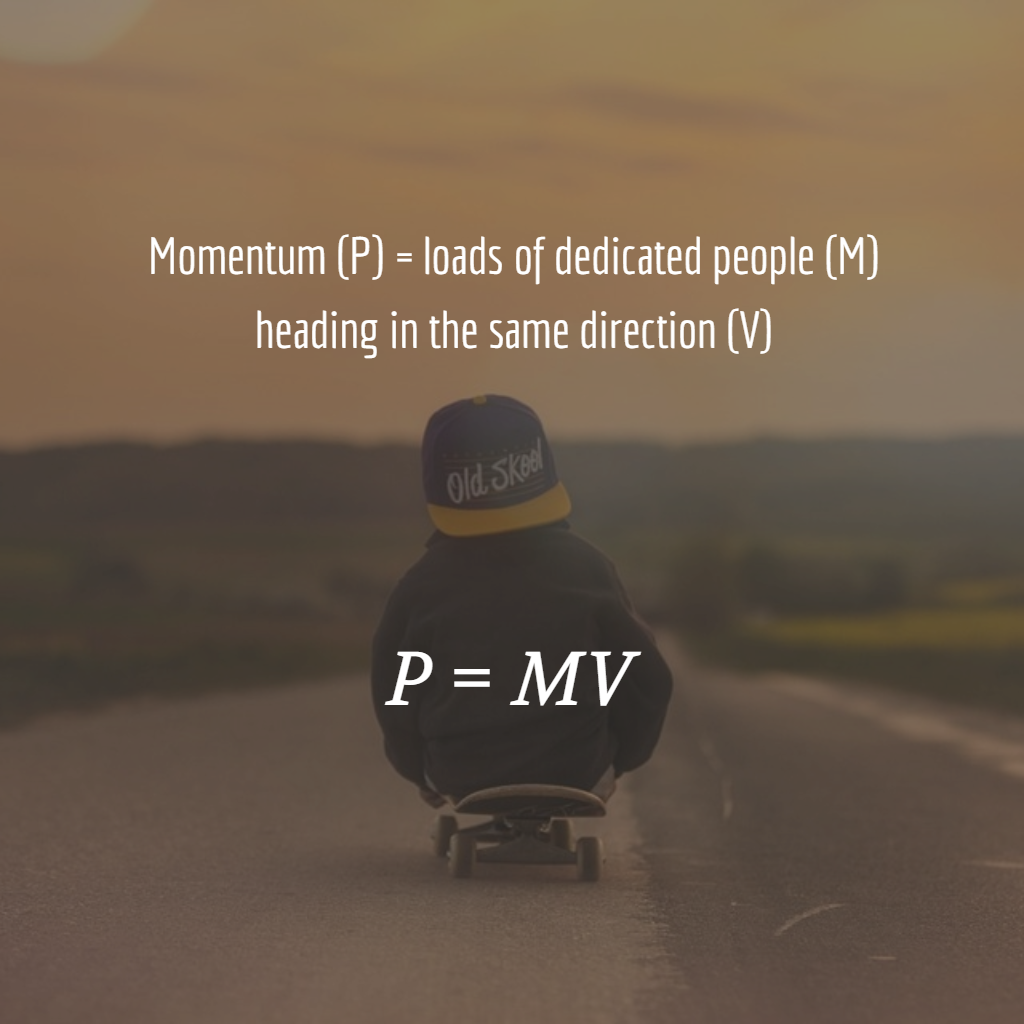
Momentum equals mass x velocity P MV

One of the things my son and I do for weekend kicks is launching ourselves down our street, which has a reasonably steep hill, on skateboards. There’s something about gaining momentum that is fun and exhilarating. And as the formula P = MV rightly points out, the bigger you are the faster you go.

As a social entrepreneur I also love momentum. I love growth. I’m not scared of BIG, and I not so secretly desire to use the organisations I am involved in, to have a global impact. I want them to take over the world and do good.

I also want the organisations you are involved in to succeed. And grow. And gain momentum. That’s where the formula comes in.

Momentum (P) = Mass (M) x Velocity (V)

Momentum in an organisation requires Mass & Velocity.

Mass

Mass equals people. Without people there is no momentum.

It would be easy to think, that the more people you have the more momentum you have, but that’s only partly true. Mass is about density. And density when it comes to organisations is about quality.

100,000 likes might increase awareness, but it won’t bring long-term momentum on its own. What organisations need are dedicated, high quality people, who do great work and bring mass.

Mass is about getting as many great, activated people as possible.

Velocity

Velocity is different from speed. Speed is how fast something is moving, whereas velocity how fast it moves in a direction. Velocity is heading somewhere.

If you have 100 people moving incredibly quickly in different directions, then they are pulling against each other. You have speed, but not velocity.

In an organisation, everyone needs to be moving fast AND in the same direction.

Without velocity you have no momentum.

So…

Momentum (P) = loads of dedicated people (M) heading in the same direction (V)

[Science lesson over]

Now consider the organisations you are involved in. Do they have momentum?

More importantly.

Are you doing your best to bring Mass (dedicated involvement) & Velocity (heading in the same direction)?

We can all be apart of something big that has incredible momentum.

We just cant do it without climbing on board, and then launching ourselves down the hill.

When to settle for good enough

Often good enough is pefrectly fineOne of the first computer games I ever developed in my teens was a very simplistic helicopter game, where you would hunt out submarines and bomb them. It was simplistic for two reasons, the first of which I was learning to code, and the second because all games were clunky back then, which is what you would expect from home computers that you plugged into your TV screen.
As a young guy I was good at coding, and this knowledge allowed me to learn new skills coding in Visual Basic as I got a real job. However when I compare myself to our IT team I’m a good amateur at best.

I have in the past really enjoyed coding (I like creating new things), and right up to last year I’ve dreamed of teaching myself the latest technologies.

Then I realised, in a moment of brilliance, that it’s a ridiculous idea. To be the leader I need to be, I don’t need to be a better coder.

Good enough is fine.

Good enough is perfect for me.

And realising I’m good enough at something, is incredibly liberating.

Obviously I’m not saying you shouldn’t get better at things. I never want to stop being a better leader of leaders.

Choosing what will really make you the person you want to be is essential for letting go of what’s not.

Getting to a point where you can say ‘I’m good enough at this’, not only allows others to be better than you, but frees you from some dream which may be more of a subconscious burden than you realise.

What are somethings you’ve always wanted to be better at?

Maybe, good enough is fine.

Will it matter in 5 years time?

Prior place hamilton will it matter in 5 years timeIf you have kids who play sports I’m sure you’ve experienced the challenges of finding a park close to the ground. On Saturday after finally parking ‘miles’ away from the fields, I was walking to watch the game and came across this street name.

Prior Place (No Exit).

Apart from smiling and wondering who named the street Prior Place, it made me think of prior places I have been. Not houses or streets as such, but situations.

Places where I felt like the world was caving in. Prior times when the pressure was unbearable. Anxious places that I thought had no exit, and wouldn’t end.

But they did end.

And there was a way out.

Life, as they say, went on.

It reminded me that the worry and stress and anxiety we face today, will seem insignificant in a few years’ time.

It reminded me that I need to do my best today, and not worry so much about tomorrow.

“Do not worry about tomorrow, for tomorrow will worry about itself”

The not worrying about tomorrow doesn’t mean we don’t plan to do things in the future to fix our problem.

It does mean we don’t burn mental energy stressing about what we can’t fix today.

If you’re struggling with worry and stress about things at the moment. A great question to ask is this…

‘Will it matter in 5 years time?’

Effectively, when we look back at this prior place, will all this stress and worry be worth the energy I am pouring into it.

I can tell you from personal experience, that it almost always wont.

Why I don’t understand US politics, gun control and practically everything else.

great solutions starts with understandingI don’t understand how a person can be so broken, so full of hate, that they walk into a club and murder 49 people.
I don’t understand how guns can be used in 231 US murders each week, and the people of America not see there is a problem with guns.

I don’t understand why the right to bear arms, appears more important than the obligation for peace and safety and love.

I don’t understand how a country can be so divided down two political party lines, that democracy itself appears hangs in the balance.

Because I don’t understand, it makes it very easy for me to hold strong views. Very easy to throw stones.

Because I don’t understand, if I lived in America, I would be part of the problem.

I don’t understand because I have never WALKED IN THEIR SHOES. Been brought up with their beliefs. Lived their life. Heard their narrative.

I don’t understand because I have never sought to understand the other positions, and because I am naive enough to apply my world view, to theirs.

Great solutions starts with understanding.

It doesn’t matter the topic … gun control; global poverty; human rights; religion; overcrowded housing in Auckland; local crime; or even why your neighbour lives differently to you, if you don’t take the time to understand, you are a part of the problem.

My life is always richer, fuller and more collaborative when I seek to understand.

Changing the world, or even just one relationship, starts with understanding.

Two stories about being uncomfortable

Personal growth starts by stepping out of your comfort zone.We were chatting with a friend last night who is doing a course in Distribution of all things. I say this purely because you wouldn’t have expected it. She was telling us how she is learning to drive a forklift and strap down a truck. She has also had to do numeracy & literacy assessments, that cause her to reach deep into the cobweb covered archives of her brain, and reignite her stored knowledge. And as she talks there is excitement in her voice. She is excited to be learning something new. Something outside her comfort zone.

At work at the moment we are going through the most significant and positive structural changes since I founded the company. I have a new role, as does Jim (we really needed to find him a new role after he gave his role as GM to someone else). Most of the leadership team are reporting to someone new. And a whole bunch of people are stepping up into new roles. People are nervous and excited. Terrified and ecstatic. Uncomfortable and challenged.

These two stories reminded me that growth is uncomfortable before it is rewarding.

Personal growth starts by getting uncomfortable.

They call it a comfort zone for a reason. Because its comfortable.

But when you are learning and growing and stretching yourself … it’s never that comfortable.

Maybe it’s time you got outside of your comfort zone.

How to create space to think

Unique physical spaces, can trigger amazing changes in how we think.As I open the door and step across the threshold, I’m struck by the sweet aroma of fresh coffee. The warmth inside contrasts the crisp air outside, as does the bustle and noise of a busy café. I glance around the café and take comfort from the fact I see no-one I know.
I slide into a booth and my mind is ready. I’ve reached my liminal space.

A space for thought and focus and creativity.

It’s not a space for a catch-up (I only ever go there alone). It’s not a space for surfing the web or being connected. It’s not even a space where I engage with anyone. It is a space for thinking through one big thing at a time. It is a space where I break down a problem and mapping out a solutions.

This space is a place for threshold thinking. Taking old thinking and crossing the threshold into something new (the word liminal means threshold, in psychology it’s where the word subliminal derives.)

The reason I call this café my liminal space, is because I use the space to both trick and trigger my brain. By only ever doing creative thought at this café, I’ve made it really easy to think there.

When I slide into the booth, unpack my notebook or surface, I’m no longer drawn to read my email, and have little desire for social media, not because of my fantastic discipline, but because I have an internal narrative for this space. I have solved big problems in this space. I have built resolve for personal disciplines in this space.

Unique physical spaces, can trigger amazing changes in how we think.

Over the years I’ve underestimated how incredibly important spaces are. Spaces, places, environments are important for setting the scene for physical, relational or mental outcomes.

Here’s some more ways we use spaces…

  • Dinner at the table: Causes our family to interact and engage more than we do on the couch watching TV.
  • Lunch at a café: Allows me to engage at a deeper personal level than I would in my office.
  • Walking meetings: Walking with people and chewing through big ideas provides for more open and reflective conversation.

And of course you can have negative spaces as well. Places where you are drawn away from who you want to be.

If you want to make some changes, sometimes you need to change your spaces.

What are your spaces? What outcomes do they drive in your life?

How to stop people thinking outside the box.

It's easier for people to think outside the box, when the box doesn’t exist.You know when you repaint a room a different colour, and the first coat of the new fresh paint doesn’t look quite as you expected. You’re pretty sure it will be OK, but until you get the rest of the paint on you won’t know.

Last week, with our annual conference looming and our strategy so fresh I wasn’t sure how it would look, I decided I needed some icons/logos for our strategy.

I wanted something different, risky and evocative that would help my team grasp these new ideas.

I wanted hip.

I wanted fresh.

So, I set up a gig on a marketing design platform, so that I could get something completely new.

And I waited the 3 days … with anticipation… excited… and when the gig finally arrived it looked exactly like something we would do 🙁 … (even had our logo in it!)

Not hip. Not evocative. Not fresh.

Not usable.

The designer had given me exactly what I asked for, but nothing like what I wanted.

And it was my fault!

In my desire to give a full brief of the work, I had included links to our website and current values. This quest to be helpful created a box. A frame in which he would work. And that frame along with his desire to please, forced his design into a small box.

That small box killed creativity.

We do this often as leaders.

Unknowingly, we over-define outcomes and rules and expectations. We frame tasks so strongly they force our team to work in boxes.

And then we wonder why people aren’t creative. Why they don’t think outside the box.

It’s easier for people to think outside the box, if the box doesn’t exist.


« Older posts Newer posts »