Lead a vivid life that does good

Category: Leadership (Page 4 of 10)

Why disconnected people are more valuable to a business

IAnnual Leave‘m just back from 3 weeks uninterrupted leave, and I often joke before going on leave that I only want to be contacted if the building is burning down (that way I can get my photo of the day).

Even as CEO when I am on Annual Leave, I am on leave. It’s my time, or family time, and as much as I love my work, it’s not Agoge’s time or that of our clients. In fact there are only two things I want to know about, major safety incidents or significant illnesses, and of course the building burning down.

I believe that disconnected, uninterrupted leave is one of the most important things we can do to increase our value to our organisations. Without the disconnect of leave, passion wains, creativity dries up and resentment can kick in.

Whereas the break always helps you reconnect with the people you love. It gives you time to chill. To unwind. To clear your head. For those in physical work where the demands are different to my job. It gives your body a chance to relax, recoup and recharge.

More than anything else you become aware that work is not meant to be all-consuming.

None of this is new or a surprise. So my challenge is this…

When you take leave – do you fully disconnect?

And.

When others are away – do you relentlessly protect their leave?

I hope the answer to both is YES.

Taking uninterrupted leave takes a lot more discipline than most people afford it.

For me personally I need to discipline myself to DND my phone. To disconnect my email on my phone and laptop. And to not take an interest in work stuff.

Similarly my team needs to know, it’s unacceptable to call. And they need to be empowered to make decisions.

In the end, the discipline for everyone is worth it.

Its the question that could change your life…

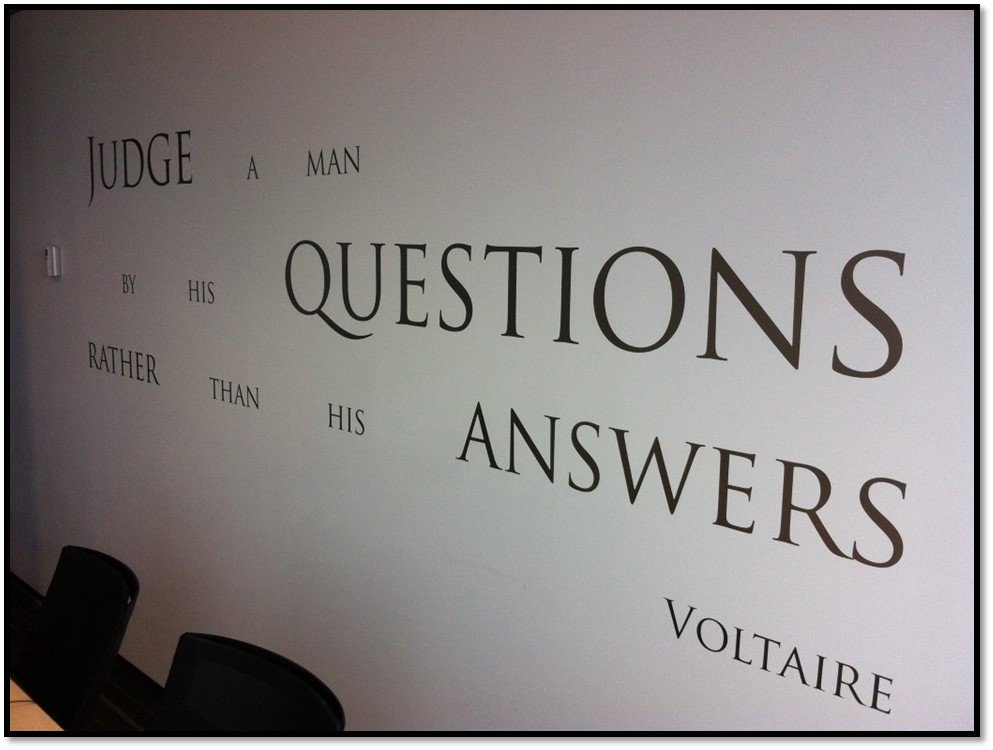
Judge a man by his questionsFor those who know me, you will know one of my favourite (and at times most frustrating) questions is “How do you mean?”

It’s a favourite question because it softer than “What do you mean?” and because it is a great way to find out exactly what the person is saying or thinking or trying to explain. It causes me to pause and be sure that I know, rather than assume I know, what the person is saying.

And as great as this question is, the most important thing is that it is a question.

There is so much power in questions. So much ability to draw in and hear what people are really saying. So much power to fully understand them.

A recent study of people involved in negotiation showed that the average person spends 11% of their time asking questions, but for the most successful negotiators this number more than doubles to almost 25% of their time. Just asking questions.

Effectively the best negotiators are people that … ask.

Listen.

Ask.

Hear more.

Ask again.

Until they fully understand the other persons point of view. And because of that they win people’s hearts, and reach agreement, and get positive movement.

All through the power of questions.

The weird thing about asking questions is that it makes me appear way smarter than I am. Often the mere act of asking questions causes people to think in ways they haven’t before. And they come away from our conversation thinking I helped them with wisdom, when all I really did, was ask questions.

So the next time you’re trying to help someone, or understand a problem. Try asking 5 questions (way harder than it sounds) before even trying to give your opinion.

When you do this, you too will discover the power of questions.

Smart people make things simple.

For many people, one of the biggest curses of knowledge is that we tend to over complicate things.

Case in point, I have been doing a lot of reading about Lean Manufacture and its application into the service industry. One book I slaved through this week explained Waste in a complex way that cumulated in the formula shown in this picture (for the record I have no idea what this actually means.)

LEAN Waste Forumla

And then, I read a simple explanation in a completely different book. Waste is non-valued added time. I.e. Doing things that don’t add value to your customers, that’s waste.

The goal of both books is to make Lean Service understandable and applicable, and yet one failed miserably.

The goal of leading people is not to show how much knowledge we have or make us feel smart. The goal is to lead our people to do great work, by keeping things as simple as possible.

The simpler we make that, the better.

3 ways to stay focused on your goals

FocusA number of years ago Bill Gates’ mother held a dinner party and invited both Warren Buffet (super rich guy) and Bill along. At the dinner party she ask what they believed was the single most important factor for their success. Both Bill and Warren gave the same one-word answer: “Focus.”

Focus is one of those annoying words that continually collides with my life. Historically I would not regard myself as a particularly focused person, but slowly over the years I have been improving. As I have improved I have realised that FOCUS requires constant, well focus, on three areas:

1. Turning Goals into Priorities

In order to be focused you must know what you are focused on. The word after all means “the centre of interest or activity.” Without having goals, both in business and personally, you won’t have interests or activity to centre yourself on.

But just as important as having goals, is reviewing them very frequently and setting actions. For me this involves a weekly review of my goals and strategies to set the course for the week, then almost daily reviewing these and setting actions for my day ahead.

Simply said. To focus you must have goals and resolve to take action daily.

2. Be in the Right Space

Now that you have your priorities you need to have a work-space where you can actually get on and do the work without too much interruption. As your all know, not all work spaces are the same. Some of us have our own office and others work in open plan.

The key thing to remember is that different focus, requires different spaces. Sometimes I need to work in my office as I need the tools there to do the work. Other times I can sit with my laptop in a café. Other times I go on a walk with a piece of folded up paper and a pen (so I can leave my phone behind). Depending what you are focusing on determines the space you should be in.

Once in the right space and ready to focus, it’s important to eliminate as many distractions as possible. This mainly involves communicating with the team around you that you are focusing a major goal for a period of time.

3. De-clutter ALL Distractions

I was reading yesterday that the average Facebook user in New Zealand checks Facebook 14 times a day. Social media is great for connection with people, but for most of us it distracts us from their goals. Similarly in our work-spaces there are distractions everywhere, so it is little wonder we struggle to focus. As I’ve become more focused I have had to take some pretty radical steps and a few of these are below:

  • Implement GTD (Getting Things Done). It’s a book. Buy it. Implement it.
  • Have a tidy work-space and try to only have the work in front of you, that you are focusing on. This stops distractions.
  • Turn off every type of email notifications on every device. My focus doesn’t last long, the last thing I need when a new email arrives is an excuse for my brain to get distracted.
  • Turn off notifications on your phone. All of them at first, then bring the critical ones back in. Social Media are unlikely to be the ones you turn back on. While you are at it, delete the most distracting apps from your phone.
  • Relentlessly remove yourself from email lists. The goal of an email is to distract you and get you to check in on their website. Our goal is to not be distracted and to have as much focused time as possible.

Distraction is everywhere which makes focus incredibly hard. If focus is important, you need to radically reduce the distraction. You can still clear Facebook, or check out websites. Just not when they prompt you and not when you are focused.

Becoming more focused is a constant struggle for me. I get constantly distracted and interrupted and I take on too much. All distraction comes at the expense of the goals I think are really important for me.

That said, the more I focus, the more I appreciate the value of focus and the more determined I become on my quest for more.

I’d love to hear if you have tips for becoming more focused, so comment and let me know what you think.
Do you have a minute?

Havea minute?I hate running on a treadmill!

Nothing does my head in quite as much as watching minute after minute tick by, while I stay in one place and move exactly nowhere.

It’s funny how one minute can feel like a blink of an eye, but when things are moving slowly or you are watching a countdown each second feels slow and a minute takes forever.

1 minute in the scheme of our lives is not much time. Even in the fullness of a day, one minute only equates to 0.07% of your day. There are 1440 of them each day.

1 minute is nothing. Unless you make it something. A minute every day … can radically transform your life.

The thing about minutes is they build-up. If you were to do a new habit for just a minute a day, you would spend 6 hours on that habit over a year! All from just one minute.

Maybe its writing in a journal. Or meditation. Or prayer. Or exercise (yes 1 minute counts). Or Reading. Or playing with your kids. Or … ?

Do you have a minute?

Just one minute.

Everyday.

Maybe it could change your life!

The other thing about minutes as they seem to extend. Sometimes spending a minute on something daily, is just enough to get you started, and very soon you are spending 5 or 10 minutes a day.

Start small with just 1 minute.

Start today.

Repeat!

Two things you need to become innovative

Creative ExecutionYou have probably all worked with people at the creative extremes. At one end is the person who works really hard, executes like crazy then tells you “I’m not creative”. At the opposite end of the scale is the “ideas person” who constantly has ideas and never delivers on anything.


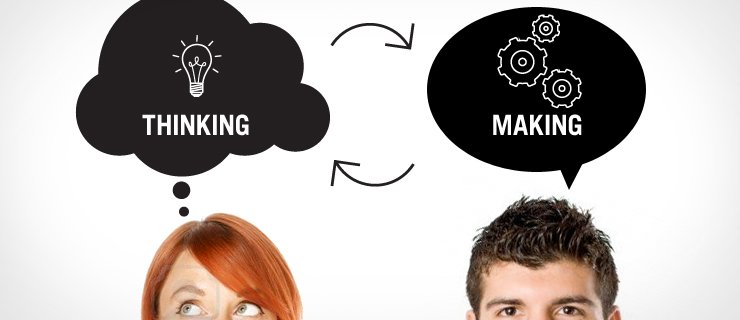
Leading these people can be vexing indeed. For the ‘executer’ you know they have a depth of knowledge that could dramatically improve your organisation, if only they took the time to be creative occasionally. And for the ‘ideas guy’, could they not stop talking and actually do something.

At Agoge two of our values are Execution and Be Creative. I’m realising that these two values are in constant battle with one another.

Being creative and execution are a paradox.

You can’t do both well at the same time. When you are in execution mode, work is about lists and priorities and completion. And when you are being creative the last thing you need to be thinking is to-do lists.

Creativity it turns out takes one thing… TIME.

Creativity requires that you take an extended break from executing.

Creativity requires leaders who are prepared to allow their team to stop executing so that they can be creative.

I desire for the organisations I lead to be innovative. Here is the formula:

Creativity + Execution = Innovation

As a leader this means I must be doing both and I must be constantly enabling my team to do the same.


How we steal peoples time

I’ve always loved the quote from Blaise Pascal who says, “I have made this longer than usual because I have not had time to make it shorter.”

Nowadays ‘this‘ can be…

handwritten penVideos,

Emails,

Reports,

Blogs,

Podcasts,

PowerPoint,

Public speaking,

And even one on one conversations.

The best of these are short and punchy. And its obvious the creator has taken the time to craft and shape a masterpiece.

When we don’t use our time to make it shorter … we just end up stealing our audiences time.

Something I constantly remind myself.


Why you should love being wrong.

Be WrongI love being wrong.

No actually that’s a lie!  Being wrong, is no fun, frustrating and outright embarrassing. Yet, I don’t hate being wrong either.

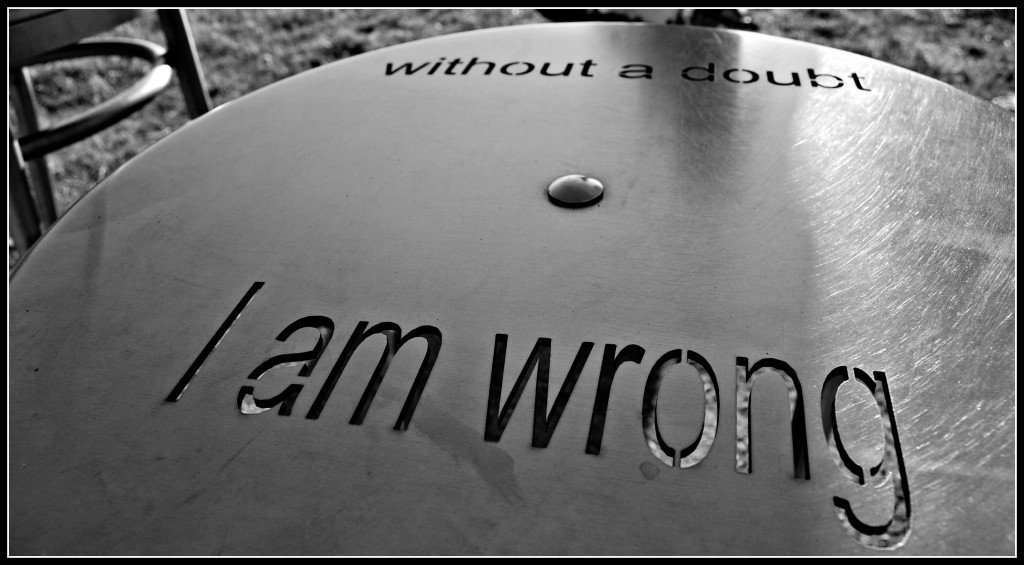
As children, most of our learning occurred as a result of being wrong. It’s weird then that most adults I know try to avoid being wrong, and in doing so miss incredible opportunities to discover new forms of right. We have grown to believe that being right about everything is good. It’s NOT.

If we are never wrong, we are never prepared to change.

And if we are never prepared to change, we never get the opportunity to grow.

So… be wrong.

Sometimes the hardest part of being wrong is admitting that this thing, or habit, or belief you have might not be right. Particularly when you have done it for so long.

Dont be afraid to be wrong every so often.

Without being wrong, we may never learn what’s right.

Are you heading for a dead-end?

SignNot far from where I live is this sign. It’s a weird sign because it curves to the right with a big arrow showing that the main road heads that way, and off to the left is a little side road.

I know it is only a warning sign; however the interesting thing about the sign is that the main road, the big arrow, if you were to keep following it, actually ends up at a dead-end. Off to the left, is the best way to exit.

I thought about how funny that is, and how often our decisions are like that sign. We follow the big road because it’s the easy path, without realising that it may end up at a dead-end. We get so fixated on following that path that we miss the opportunity to take the exit and try a new path, one with all the uncertainty that leads us someplace new.

And so we stay on the beaten track, and hope beyond hope that it won’t be disrupted.

We know though, that great leaders are defined by great decisions.

And great decision-making is generally not a massive fork in the road where it’s a choice of one or the other. Rather, it’s a series of small decisions to venture off and try something new.

Something courageous.

Something that changes the course of your life, or business, for the better.

What decisions are you not making at the moment?

What paths are you following purely because you haven’t stop to review your options?

Is it possible that you’re heading for a dead-end?

Maybe today, it’s time to take the lead and head off somewhere new.

I don’t get time to …

I don’t get time to … think

I don’t get time to … exerciseclock

I don’t get time to … read

I don’t get time to … do good

I don’t get time to … play with the kids

I don’t get time to … relax

I don’t get time to … [fill in the blank]

You are right of course.

You only get time to do the things you choose to do. You can’t make time, but we can lose it doing the wrong things.

Like me you probably need to stop doing some things, to make time for the things that are really important.

« Older posts Newer posts »