Lead a vivid life that does good

Category: lead vividly (Page 9 of 18)

Why you should believe in failures like me.

School Report Tauranga Boy CollegeI failed at school.

The best mark I received was an internally assessed A1 in School Cert science. It belonged to another student called Andrew Nichol and was whisked away as quickly as it arrived.

I left school at 17 barely able to read, average at the more complex forms of maths, but strangely very good at accounting. Despite being a “failure”, I have discovered I am actually not as dumb as the school system lead me to believe. In my adult years I taught myself to read (by reading more and more books I actually enjoy).

I have also been given incredible opportunities to lead.

To learn.

To succeed.

Why?

Because throughout my life, many incredibly courageous people have believed in me despite my failures. They were courageous because I could have crashed, failed again and tarnished their good name.

I would not be who I am today without their generosity.

All of us have people who’ve believed in us against the odds. Therefore the implication is simple.

Who are we investing our time into, who might just succeed if we just see past their failure?

Who are you believing in against the odds?

Maybe its time you found someone.


Finally a shout out to just a few of the names I have randomly thought of as I wrote this post. Mum & Dad, Craig Jamieson, Dale Henderson, Bob Addison, Matt Ruys , Neville Stevenson, Ian Hogan, Colin Shotter, Dave Medhurst, Geoff LeCren, Glyn Gray, Jeff Smith, Bruce Thomson, Mark Thompson, Iain Hill, Jim Quinn,, Rowland Forman, Ken Frost, Campbell Forlong, Jim Grafas and of course Karina Nicol. Thank you for believing in me at various stages in my life. I am more grateful than words can express.

2 ways to learn from experience.

Waihi_Beach_SafetyThere is perhaps nothing more quintessentially New Zealand, than a day swimming and playing in the surf. As a child’s age and experience increases, so does their confidence. The waves they catch now are a far cry, from the waves they ran from as toddlers.

There is also perhaps no better example of experiential learning, than learning to be safe in the surf. You could read up on beach safety, but until you have been tumbled by a huge wave and felt the current ripping along the beach, the theory means little. Unfortunately many people in New Zealand get into trouble on our beaches because the rely solely on their own, very limited, experience and don’t learn from the knowledge of others.

Our best learning comes in two ways, through a blend of our own experience and from the experiences, struggles, skills and wisdom of others.

If you really want to learn quickly, constantly seek both.

Lately I have had the opportunity to lean in and glean insight from a few very talented people, many of them younger than me. Their stories, their background and their actions form unique lessons that have portability across many areas of my life.

I have been reminded that it is important to learn from my own experiences, but it is equally important to learn from the experience of others.

I think we forget to do the later all too often.

Being the best.

Trae - "My Mum is the best"I was honoured to hear a friend give a talk about being the best in everything she does. She spoke of what it means to be the best in her music, as a mum, for her boys and at agoge.

Her words reminded me how striving to be the best is difficult and I was challenged about how often I settle for less. What follows are a blend of her words and mine as I contemplated what it means to be the best.
Being the best means failure, as you struggle to live up to your own expectations

Being the best means embarrassment, as you publicly stumble along the way

Being the best means getting it wrong, as you learning new ways

Being the best takes risk

Being the best takes courage

Being the best takes sacrifice

Being the best takes faith

Being the best takes diligence

And the best of the best do all that … with humility and love.

Be the best!

Being near water brings life.

20121223-062750.jpgI’m drawn toward water with the same force that gravity draws me to the ground. The ocean’s pull is strongest of course, but lakes, rivers or small bubbling brooks cause me to pause, breathe and relax.

To say I love being near the water is an understatement. I love running by the water. Love talking with friends as we slowly meander along the water’s edge. Love sitting alone by water, disconnected from the complexities of life.

When I am angry, frustrated and speechless, being near water somehow brings perspective. If I’m contemplative, strategic and lost in my thoughts the presence of water often provides clarity.

I was reminded the other day as I walked that it is ‘good to be by the water’.

Water…

By drinking it, we gain life.

Being near it, refreshes us.

And Living Water, heals our souls.

This Christmas … may you be drawn to water.

We are all weird

a_weird_backwards_photoI’m weird!

I know I’m weird because the other day I was cooking a BBQ, fooling around and using strange voices. Out of the corner of my eye I saw a neighbourhood kid in the yard steering at me with a look of part bewilderment and part horror. I asked if I was being a bit weird and she nodded slowly. “I bet your dad does weird and crazy things at home?” I inquired hoping for a favourable response.

Her face lit up as she replied “he sure does”.

“We are all weird Marama,” I replied with a smile,  “we are all weird.” And with that she nodded and carried on playing with my kids.

Funny isn’t it how we can behave weirdly at home, but we conform in public and at work. For some strange reason we don’t want people to know we’re weird, even though we know that everyone is a little weird.

I wonder if life wouldn’t be a little more fun and vibrant if we weren’t weird when we’re out more often. I wonder if that wouldn’t help us break down more barriers, laugh more, and enable us to not take ourselves so seriously.

We are all weird.

Therefore… do something weird today!

I dare you!

2 lessons about leadership I gleaned while being driven through Phnom Penh.

Those of you who have travelled through parts of  Asian know how mad, crazy, radical their driving can be.

[vimeo http://www.vimeo.com/54691916 w=500&h=282]
If you haven’t, watch this short video of a normal intersection at 6:30 at night.

At first we described it as ‘Organised Chaos’ and soon realised that it was best described as “Disorganised Order”. Everyone headed were they needed to go, in an orderly yet apparently disorganised way.

The drivers themselves were probably the most fascinating part of the driving experience. They’re a paradox of determination and grace. They wanted to get there first and fast, but were gracious as others pushed and squeezed their Tuk Tuk’s into gaps that moments before didn’t exist.

Disorganised Order,

and

Determination with Grace.

Disorganised Order, you don’t see that much in business or law in New Zealand. I wonder if it isn’t the essence of being truly entrepreneurial.

and

I have met plenty of determined people, and I have the privilege of knowing a lot of gracious people. Sadly, most often the determined people are not characterised by grace.

Determined with Grace, describes the leader I would like to be.

2 tips for being more generous and compassionate.

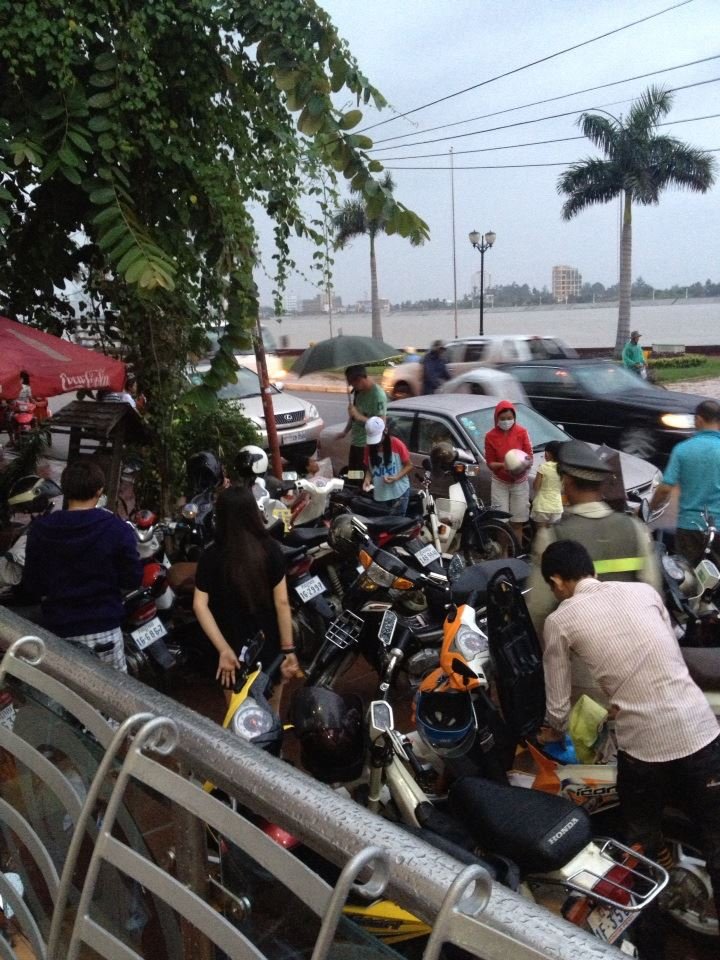
On a wet humid evening we sat outside on the bustling street corner, in the heart of the action, waiting to enjoy our meal. The restaurant we chose, our clothes and the colour of our skin screamed to the locals that we were wealthy foreigners to Phnom Penh, and almost immediately we were confronted with invitations to purchase or give. Girls the age of my daughters selling bags, young men selling books and a Mother with a young child simply begging. At first we engaged with them, then quickly learnt it was easier to ignore them and their need.

Later as we meandered along the streets we saw a young child (12 – 18 months) standing on the footpath. I glanced down to see her mother bent over a rubbish bag scavenging for food. As I walked past I realised it was the women who had begged from us at dinner. The woman and child I had ignored. I returned and gave her some money, she thanked me, and went back to scavenging in the rubbish.

I learnt some lessons that evening, learnings that have implications beyond the poverty encountered in Cambodia.

We must be prepared to give:
When I hit Cambodia I hadn’t formed this thinking, which meant each situation I encountered required me to make yes/no decisions. Soon the answer just becomes NO.

You can’t fix everything you see, so being prepared means having the forethought to know what you believe in giving to, and how much. And to whom.

This applies equally back home. Knowing what we will give to, helps when people knock on the door or telemarketers call. Importantly knowing what you believe in giving to, means you will give. If you’re not prepared the answer quickly becomes NO.

We must be ready to give:
If being prepared is a state of mind, then being ready is practical. For us it meant having small amounts of money available for donations. Whether running in the morning or on a Tuk Tuk, we had money to give without hesitation to make a small difference.

At home, I barely ever carry money, and therefore it is significantly harder for me to give without hesitation to make a small immediate difference.

I know a lot of people like me have a heart to give, to be compassionate and yet miss opportunities. So may you prepare your hearts to know when and how you will give. And then may you be ready to give without hesitation.

May you encounter the joy of making a difference.


Lesson 1 from Cambodia visit 2012: Being prepared to give.

Creating a personal strategy to help you achieve your dream and goals.

GoalsOne of the funny things about returning from annual leave is that I often have this utopic desire to live a more purposeful life. I guess the relaxation, uninterrupted time with family and the space to think, lead me to want to create more of those spaces in my normal life.

Recently after returning from leave I realised that in our business we have strategies to move us towards our vision and these strategies help us choose the right actions.

In my personal life however, I had never put strategies in place and this needed to change.

Understanding the difference between vision and strategy and actions can be difficult so here is a personal example.

  • Vision is your dream or long-term goals. One of my visions is to “be a person of influence” (hopefully a positive one).
  • Strategy is a high level way of getting to your vision. My current strategies for increasing influence are “connecting with 4 people each week” and “writing weekly”.
  • Actions are the things you do each week to get that align to your strategy. My actions are appointments I have with people and time I actually spend writing.

The truth is I haven’t written each week and I haven’t met with 4 people each week. But, I have written more and connected with more people each week. I also track how I am going in my personal weekly check list which I review in my weekly review (this is the key to not forgetting it).

And even though I don’t achieve it each week, my influence is growing, and I am meeting and connecting with more people, which is energizing me and making me a better person.

Most importantly each week is deliberately better than it would be without them.

So what will your strategies be?

If you would like to see my current strategies, I have posted them at outward.me.

4 tips for losing weight, quitting smoking and changing habits.

Our conversation was casual and jovial as we talked of my friend’s attempts to quit. Like all of us he had tried and failed on more than one occasion, except he was trying to give up smoking, an addiction I have never had to break.

As we chatted through the failed attempts of the past I said to him that he had never ‘resolved’ to give up. He had never really decided. He had not truly decided that he would never smoke again, and until he did all the quit smoking aids in the world would not help him.

He asked, as I would, “OK then, how do you get resolve?”

Around the same time another friend was losing weight (36kg in 6 months to be exact). He had lost weight before, he had tried and failed on more than one occasion, only this time something was different.

This time he has resolve.

I can hear it in his words. I can see it in his eyes; there is a steely-eyed determination to make this stick.

Resolve is different to self-discipline. Resolve is a determination and self-discipline is the habits that keep you on track.

Having been asked, “How do you get resolve?” my answer at the time was simple. I don’t know. I know when I have it, but I don’t know how to make people get it.

From my experience however the progression towards resolve goes a little something like this:

1) Know the Change.
If you don’t know you need to change you wont. Knowing an addiction or habit is bad is quite different from knowing it is incredibly bad for YOU.

2) Know the Future.
Maybe this is a specific goal like a target weight; maybe it’s knowing you will be a better leader by changing a habit. In any case you need to appreciate how the future you will be. Some could call this a goal, or a dream.

3) Know the Support.
Before you get resolve, somehow you need to know you have the people, tools or support to get you through. Giving up smoking if everyone around you smokes is almost impossible. Trying to lose weight without tracking what you eat, wont happen.

However, if you know you have supportive people, smoking patches, food diaries, whatever before you start, you are far more likely to succeed.

4) Now Decide.
Now the key to resolve is deciding. At some point you need to be by yourself, know change is needed, know what you want, know you have support and then decide.

Really decide.

No one can do this for you, and I wish I could tell you how to decide, but I cant.

I do know from personal experiences to lose weight, exercise regularly for the rest of my life, make decisions quicker, reduce debt or lead better, that it takes full resolve to get through.

A half-hearted resolution is not resolve. To have resolve is to commit fully. In hindsight and somewhat strangely I can tell you exactly where I was when I made most of my big decisions.

Even the language of a resolved person is more determined.  I will always do… I will never … For the rest of my life … For the next 30 days I will…

The rest is easy easier.
Once you have resolve you will still have bad days, still be lured to old patterns and often struggle with the task at hand.

Habits need to be changed after all and changing habits takes time. But once you have resolve something in your core has changed. The default is different. Your self-talk is different and you slowly but surely make it.

My friend has stopped smoking. Both friends have resolve. I didn’t give it to them. They decided for themselves and it has been life changing.

So…

I hope you shoot for your goals.

I hope you get the resolve you need to change.

I hope your life is changed.

And if I can help in any way I would love to chat.

20120602-070846.jpg

I wonder what important parcels or documents are on board this DHL plane? I am sure that somewhere a person waits for the arrival of a parcel, that is possibly the most important thing in their life right now.

At the conference, most of the speakers felt like they had something important to say. They have important jobs, and it was critical they get their learning across.

Important comes from the word import. To import means to ‘bring in’. We can tell what is important in our lives by the things we ‘bring in’. What we buy, how we spend our downtime, who we talk to, all indicate the things we think are important.

Lets be honest for a moment. Important focuses on ME!

Exportant is not a word but maybe it should be. It would mean to ‘give out’. Maybe our lives should be measured less by what we bring in and more measured by what we give out.

Then how we spend our money, our downtime and how we talk to people, would be focused on what we give out, rather than what we bring in.

Then we would be exportant.

And most probably what we actually do, would become genuinely important.

« Older posts Newer posts »